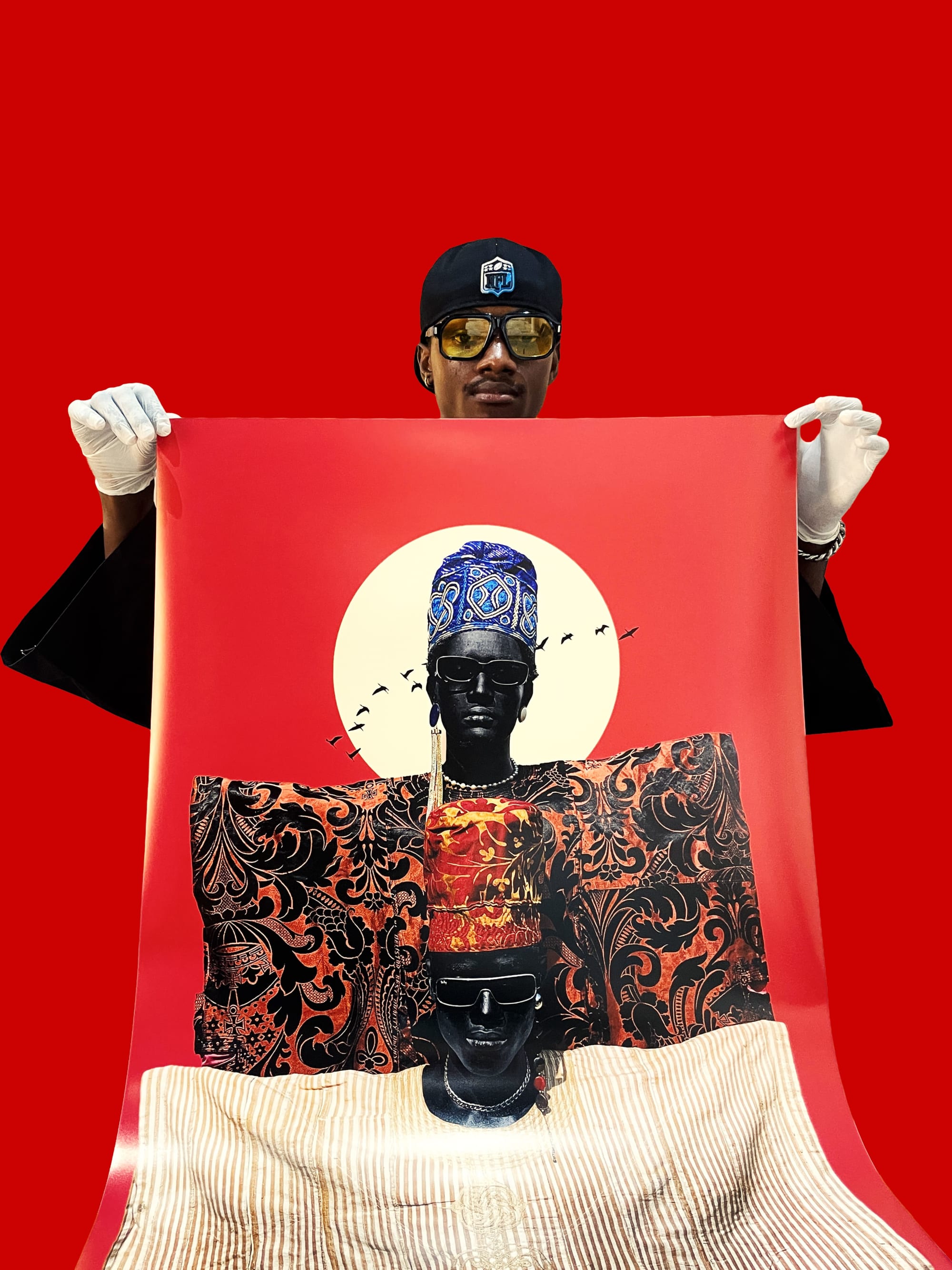
In my earliest memories, color was never just decoration. My mum ran a textile shop, and I would sit on the floor while she matched fabrics with a precision that felt almost spiritual. She didn’t just sell clothes, she arranged lives. Weddings, burials, festivals - she had this way of knowing which color and pattern would carry the right energy. That stayed with me. Later, when I started making art, I realized I was really just extending her work. Finding stories in fabrics, weaving memory into image.
But I also grew restless. Everyone around me seemed to be leaning on the same visual references, wax print, Ankara, patterns already loaded with someone else’s authorship. I didn’t want to just recycle what was already mass-produced, what was controlled by markets outside of us. That frustration turned into an obsession with making my own visual language.
Afro-maximalism, exaggerated contrasts, color theory turned up loud, figures exaggerated almost beyond proportion. I wanted to show my world not as a quiet echo, but as a full-throated shout.
Malick Sidibé taught me how everyday people could stand like legends in a frame. His photos of Bamako made me realize Lagos has the same heat, the same electricity. When I look at the Ojude Oba festival back in my hometown, or kids on my street tying socks into footballs, I see material for myth. I don’t want to just document it. I want to amplify it until it feels larger than life. Yinka Shonibare gave me another angle, how to turn fabric into a critique. But Sidibé’s eye for life in motion keeps pulling me back.
I lean on symbols, flowers for growth, butterflies for hope, contrasts for tension. They all slip into my compositions almost like subconscious visitors. Sometimes I don’t notice them until after I’ve finished. Maybe that’s why my work feels so alive to me. It’s part planned, part accident.
What I want to do now is to reexamine how history sits inside our textiles and our images. We inherit fabrics that tell other people’s stories, we carry colonial remnants on our skin every Sunday, and yet we keep making them ours. I want to push that tension into spaces that aren’t just for viewing but for communities too. I imagine immersive installations where people walk into a room and feel like they’ve entered a living fabric, where bodies, color, and sound fold into one another.
This isn’t only about art, it’s about agency. If I can create images, patterns, and spaces that belong fully to us, then maybe I can break the loop of repetition and hand-me-down narratives. My goal isn’t perfection. My goal is to insist on vibrancy, on the African cultural landscape as it is and as it dreams to be.